Arnd Gatermann
City guide Lemgo | A tour of a city well worth visiting
Sightseeing tour (→ Zur deutschen Version)
A concise online travel guide containing the key information you need for a self-guided city walk and an enjoyable stay in Lemgo. Text in blue contains links to websites with further information.
First, there is general information about the town, museums, art and restaurants. Further down, you’ll find photos and descriptions of a walking tour of the town. At the very bottom, there are tips on how to get there and instructions on how to reach the starting point of the tour.
(Translated from German into English using https://www.deepl.com/de/translator)
Lemgo is lovely!
The old Hanseatic town of Lemgo was founded at the junction of two trade routes. Mittelstraße, which runs from west to east, is the main shopping street. Running from north to south is Breite Straße, which is lined with smaller shops, restaurants and the Hexenbürgermeisterhaus museum. The market square is situated next to the junction. Known as the ‘Steinerner Saal’ (Stone Hall) due to its compact layout, it serves as a venue for events and dining. During the weekly market on Wednesdays and Saturdays, you can sit at the outdoor dining areas right next to the market stalls and watch the hustle and bustle.
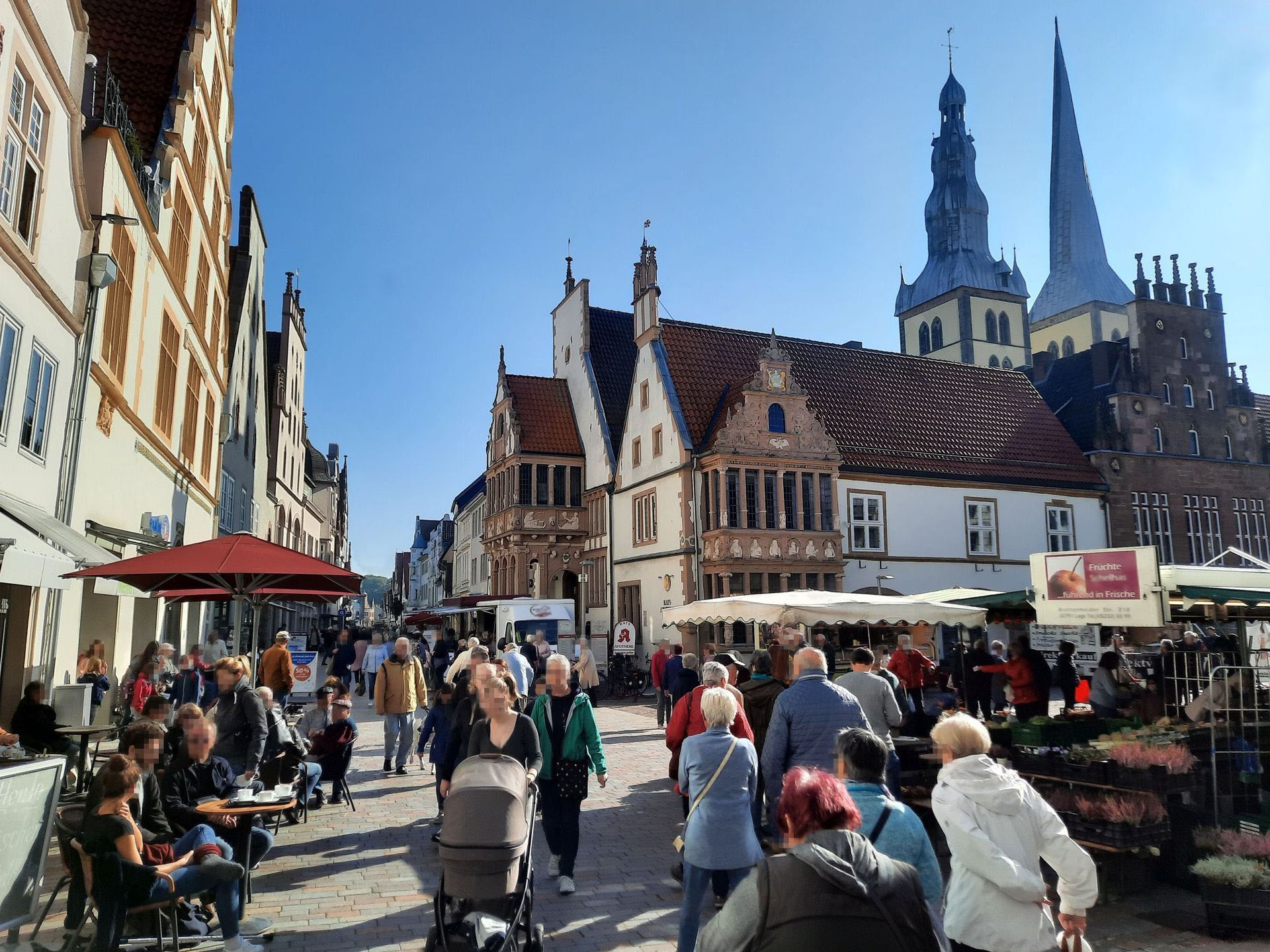
Particularly popular with tourists are the beautiful Weser Renaissance façades on the market square and the magnificent half-timbered gables on the eastern section of Mittelstraße and on Breite Straße. The streets running parallel to Mittelstraße – Papenstraße and Echternstraße – feature lovely little half-timbered houses.
The town centre is surrounded by ramparts, mostly lined with large, old trees. A circuit on foot, by jog or by bike is just under 3 km long. To the south, the Hohe Wall and the Lindenwall are still at the same height as the former town fortifications – walking there feels like walking along a dyke.
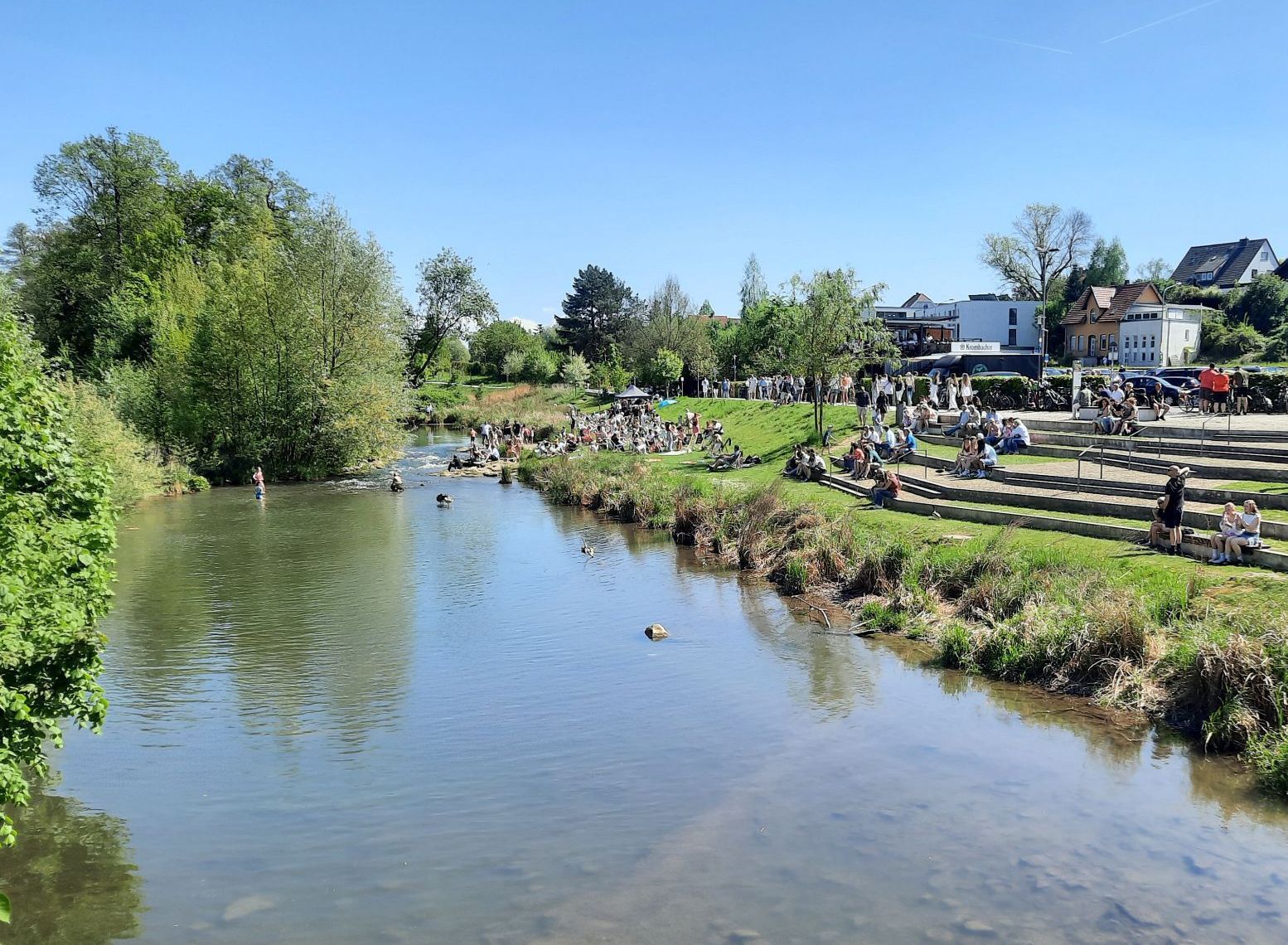
To the south of Breite Straße, behind the Alte Abtei (the building with the curved external staircase), you’ll find the Abteigarten, which has a café and a beer garden. If you head south across the bridge over the River Bega, you’ll see the start of the Auenpark with the ‘Strandlicht’ beach bar. Here, in summer, you can borrow deckchairs free of charge and sit on the lawn by the river.
Museums and Art
The Hexenbürgermeisterhaus Museum in the city centre showcases the town’s history and hosts special exhibitions. On the outskirts of the town centre are further museums: the Weser Renaissance Museum at Brake Castle, which is of national significance, and the quaint Junkerhaus with its many carved wooden ornaments. Both are no more than 1.5 km from the market square. The Eichenmüllerhaus, a municipal art gallery well worth a visit, hosts frequently changing exhibitions. Anyone wishing to see art in an outdoor setting should head to the “Staff Landscape Park”, take a stroll there and enjoy the view over Lemgo and the Lipperland region.
News
Lemgoer World of Ice until 17.1.2027
Funfair Kläschen (Kläs'chen) 3. bis 6.12.2026
Gastronomy
Along the city walking tour, you’ll find places to eat at the market square, on the western and eastern sections of Mittelstraße, in the central part of Echternstraße and on the eastern section of Papenstraße. Recommendations for lunch are marked with an *asterisk:
Currywerk*, Lippe Lounge*, Me Lounge*, Starnberger Wirtshaus*, Pinocchio*, Amico*, Café Vielfalt*, Luisa, Jovel, Café Mia* (Wed-Sat), Anh Béo*, Beer garden behind the Old Abbey, Vesuvio*, Meg and Ankaplatz*.
Ice-cream parlours: Venezia, Dello´s, Piccoli, San Remo and ICE Box.
Cafés: Alte Remise (Thu-Sun), Café Mia (Wed-Sun), Meffert at the market square (Mon-Sat), Komplizen, Café Vielfalt. Please check Google Maps or the websites (blue text with a link) for addresses and opening hours.
A tour of the sights
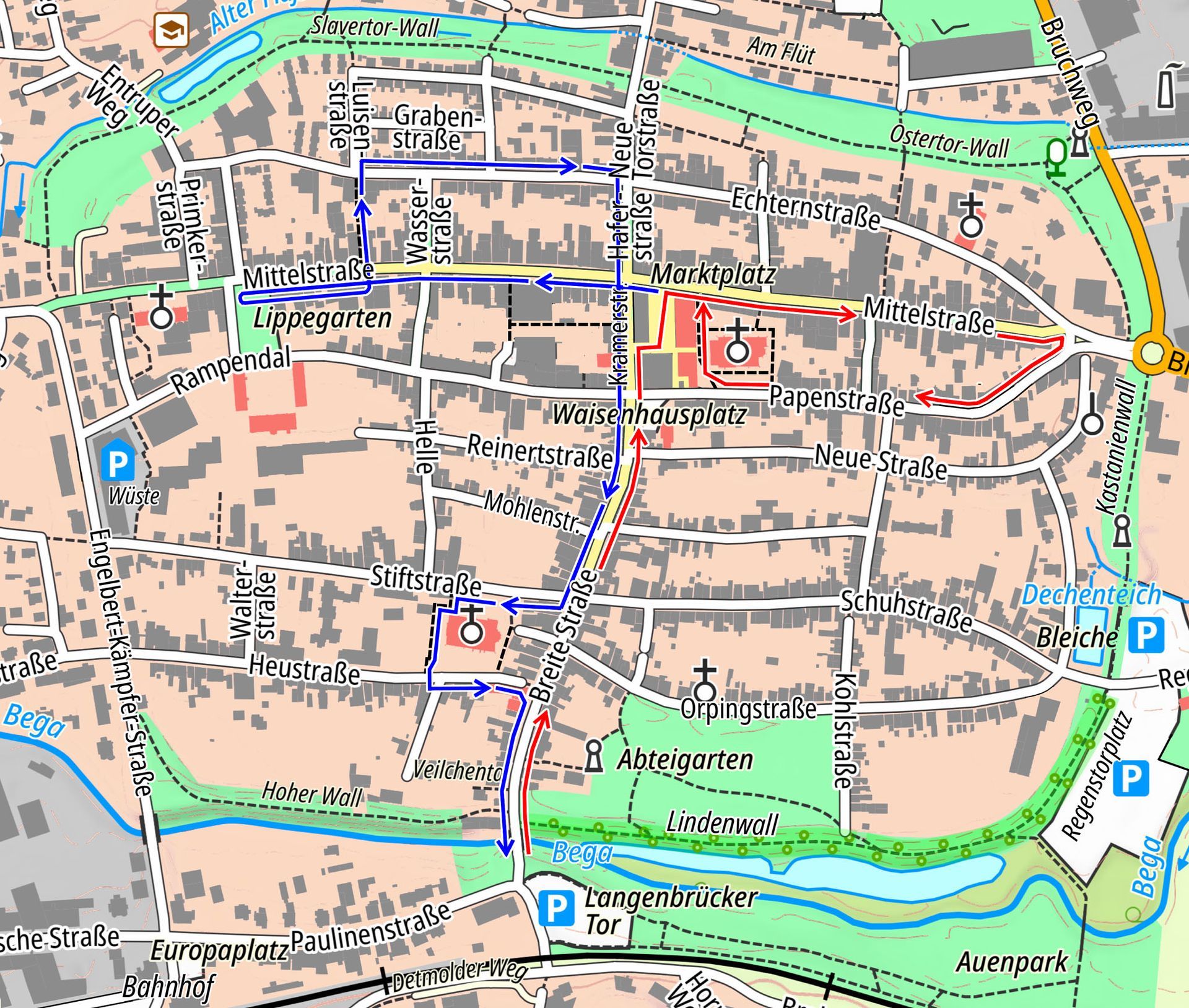
From the southern end of Breite Straße, the route heads north to the market square, then along the eastern section of Mittelstraße, through Papenstraße and across Kirchplatz, before returning to the market square. If you walk back to the starting point from there, the circular route is 2 km long.
If you extend the circular walk to include the western section of Mittelstraße and Echternstraße, the total distance back to the starting point is 3 km, which takes about 30 minutes at a normal walking pace. On top of that, you’ll need to allow time to look at the sights.
Breite Straße (The tour starts at the southern end)
From the bridge over the Bega, walk towards the green-roofed church tower of St Mary’s and you will soon come to the large building of the Alte Abtei on your right, with its curved external staircase. Just before the corner of the building, it is worth taking a short detour to the right into the tree-lined abbey garden, which features a beer garden and a café in the old coach house.
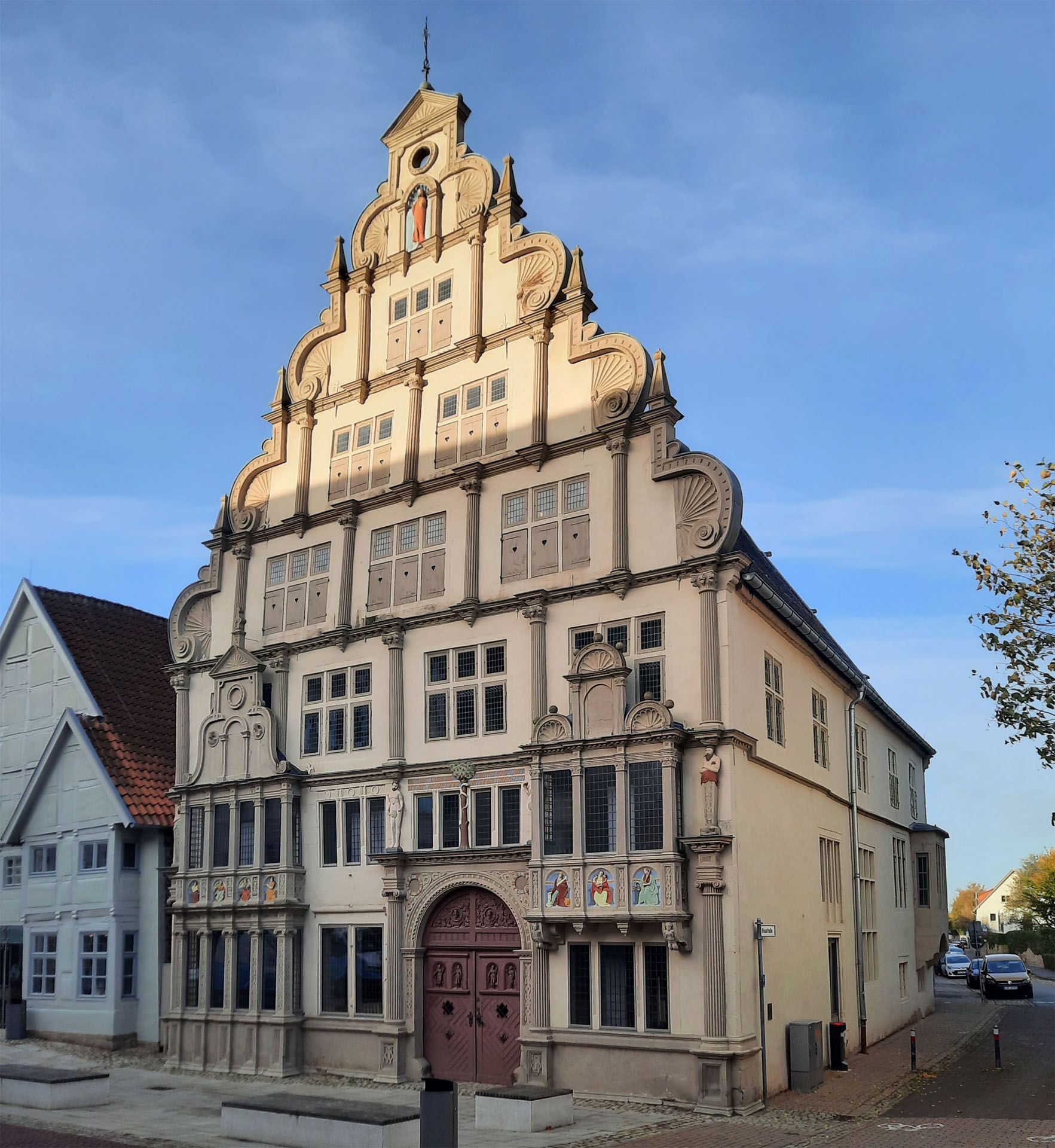
Back on Breite Straße, you’ll come to the Hexenbürgermeisterhaus on your left, with its magnificent façade dating from the Weser Renaissance period. The municipal museum housed in the building offers free admission. Even if you don’t have time for a proper visit to the museum, it’s worth popping in briefly to see the building from the inside and have a browse in the museum shop.
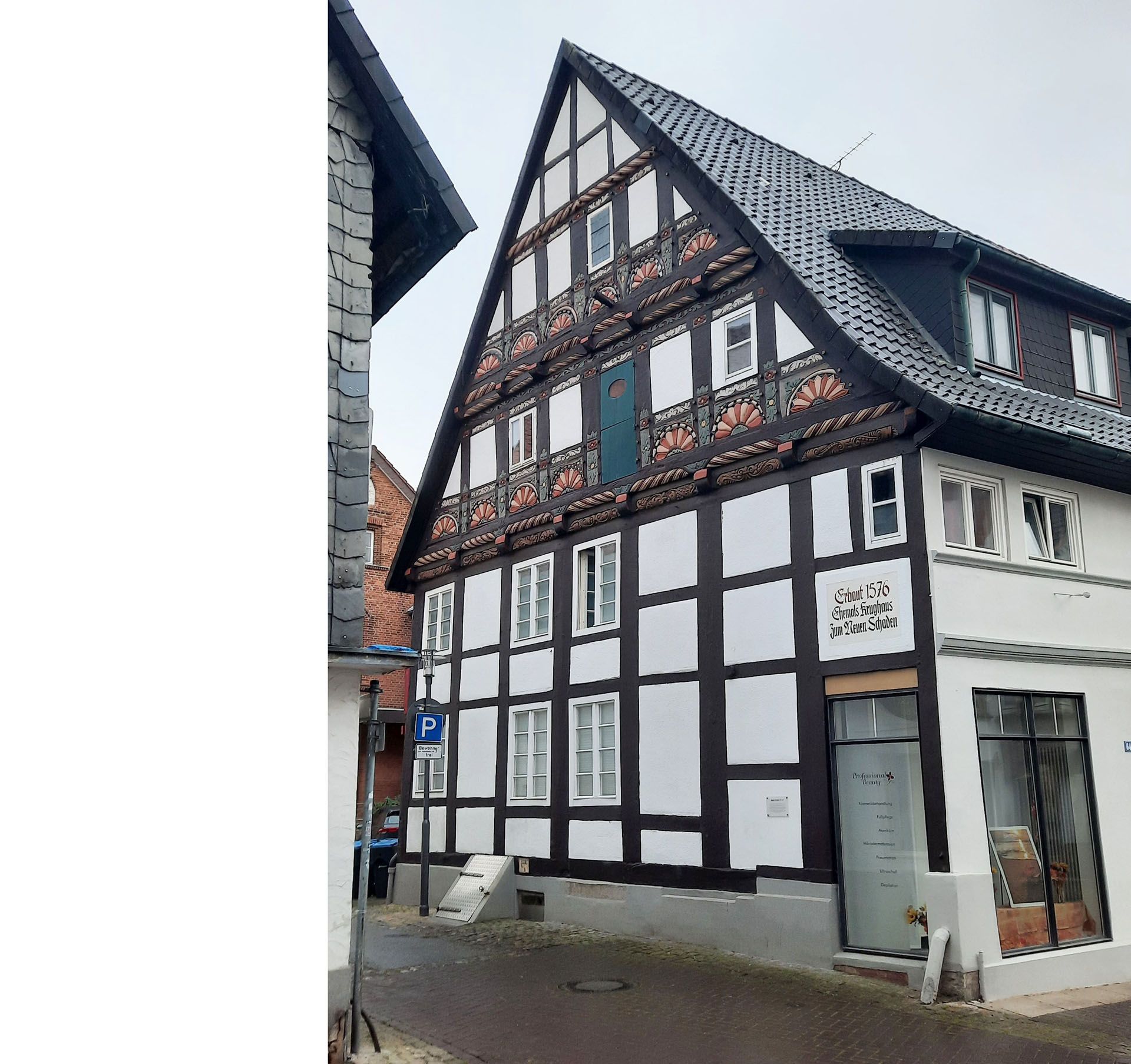
On the right-hand side of the street, at number 24, you can see an unusual decoration right at the top of the house. Further along the street, on the left-hand side behind Mohlenstraße, there are two houses with magnificent gables.
A little further down the street, it’s worth taking a few steps to the right into Neue Straße and then turning round. Here, you can see carvings and gilded lettering at the top of the house. If you look up at the left-hand side of the building from where you’re standing, you’ll also see some very beautiful coloured decorations. If you continue along Breite Straße, you’ll come to a square.
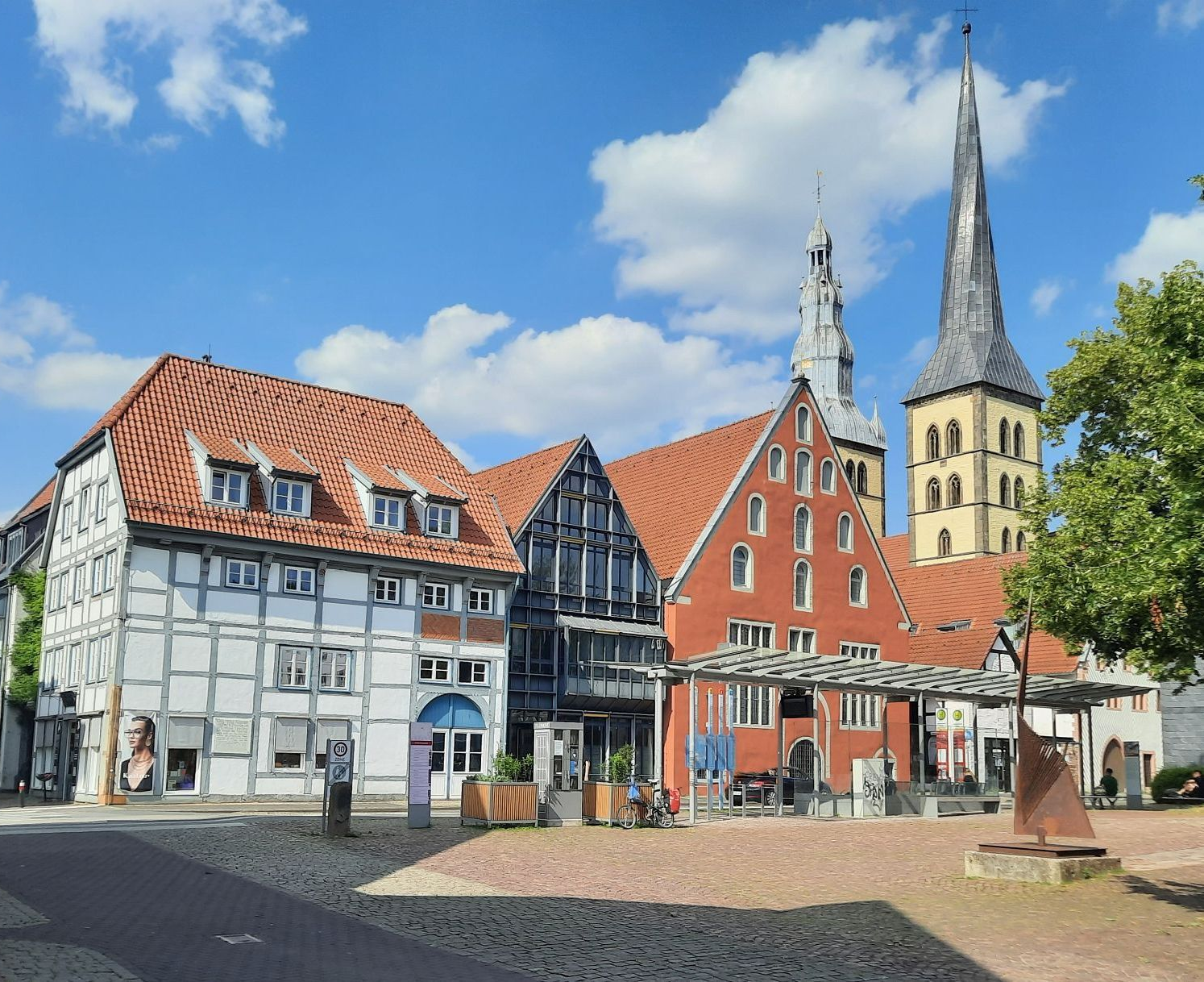
Waisenhausplatz (Orphanage Square)
Coming from Breite Straße, you can see the towers of St Nicolai on your right. The pointed tower on the right belongs to the church, whilst the one on the left, with its curved outline, belongs to the town. Right at the top of that tower is a watchman’s room with a fireplace, a living area and a lookout point.
If you walk across the square towards the bookcase (centre of the picture) and look back in the direction you came from, you’ll see a row of half-timbered houses and, on the right, a stone house with wooden shutters on the façade of the upper storeys.
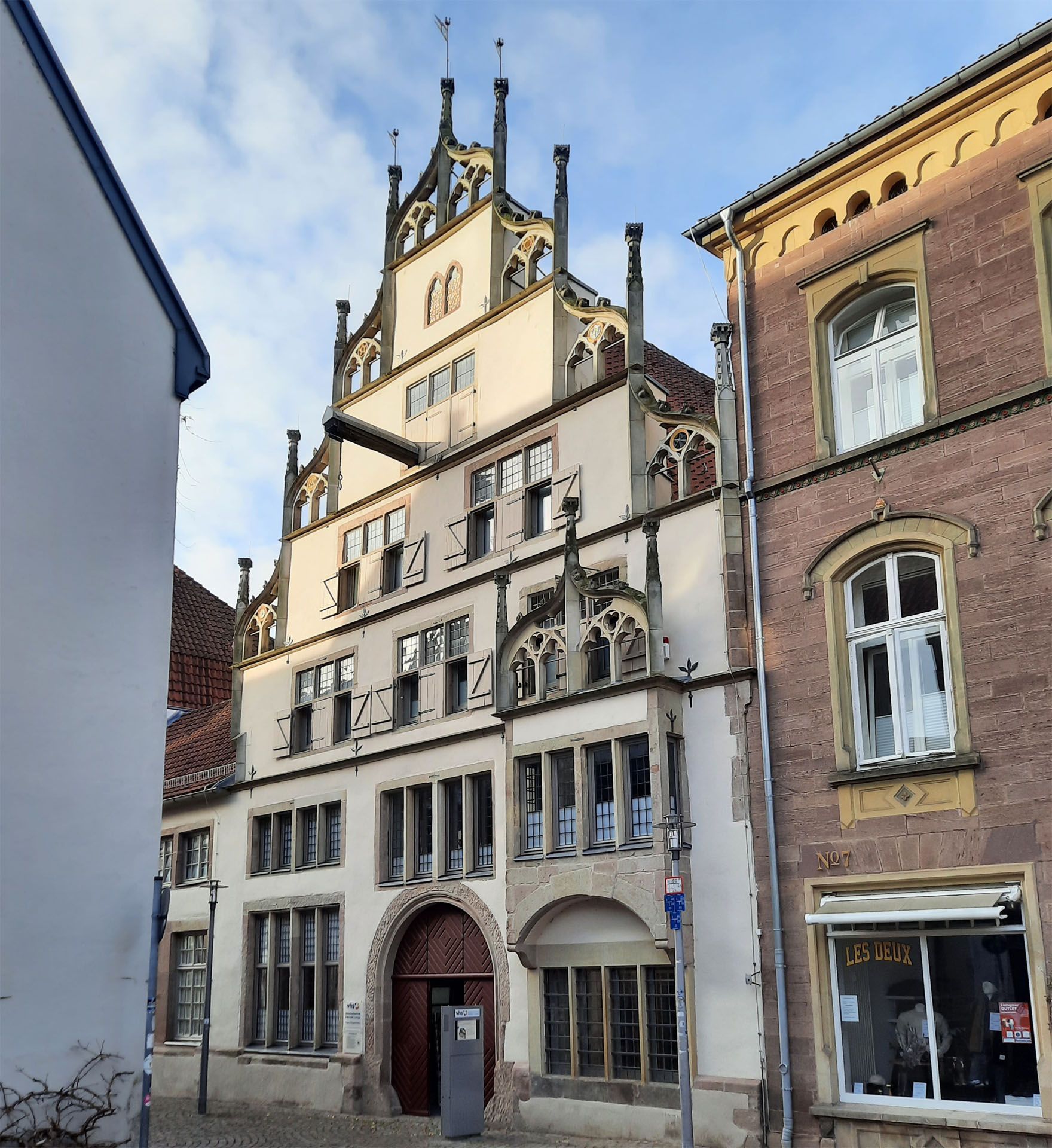
Kramerstraße
If you cross the zebra crossing, you’ll find the Tourist Information Centre in the corner building on the left, offering leaflets, books and high-quality souvenirs relating to the town of Lemgo. A few steps further on, on the left, stands Haus Wippermann, a former juniper distillery with an imposing gable. The building houses the adult education centre (VHS), and it’s well worth taking a look at the large, ornate stone fireplace in the entrance hall. If you then turn right, you’ll reach the market square.
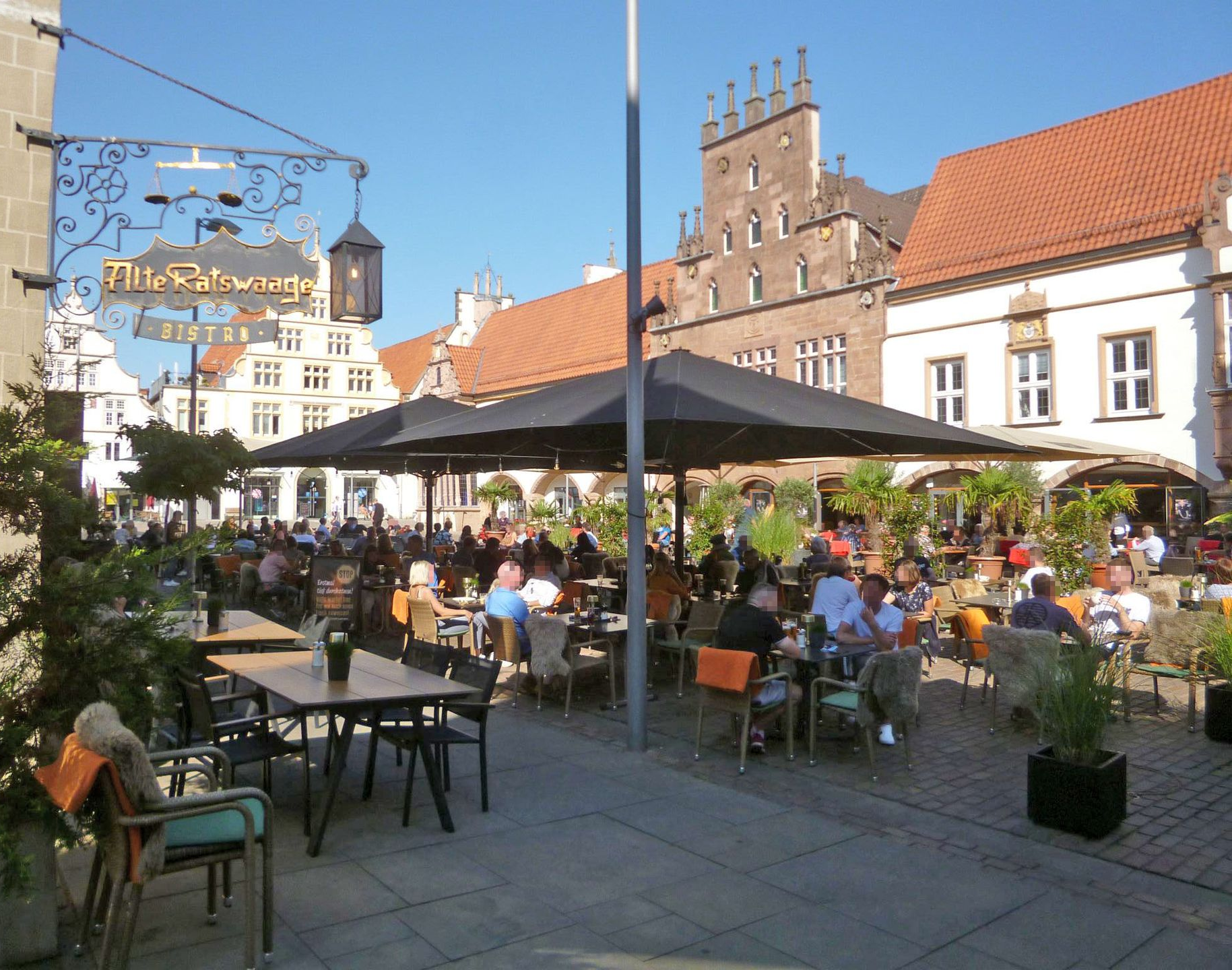
Marktplatz (Market square)
The entire eastern side (on the right in the picture) is the town hall, which is accessed from the rear. On the ground floor there is a restaurant featuring the old Ratskeller, and to the left a chemist’s with its richly decorated bay window. Just round the corner is the Rathauslaube, featuring further figures carved in stone. The red building to the south is the Ballhaus. In the past, people used to dance there; today, weddings are held there. Diagonally opposite, on the corner, is the Alte Ratswaage, now a restaurant. To the north, you can see magnificent Weser Renaissance façades, which are particularly beautiful to look at in sunny weather.
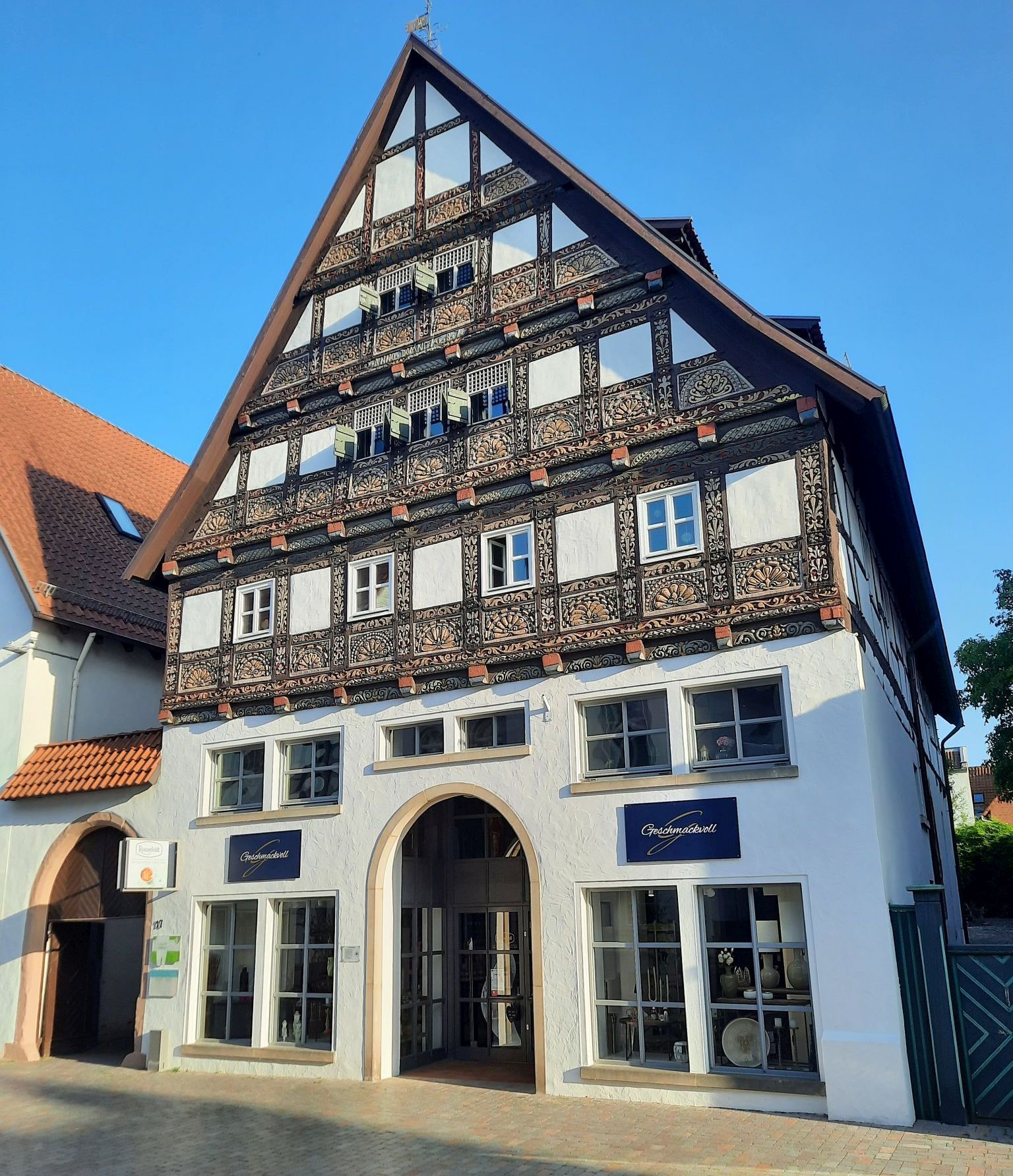
Mittelstraße, eastern part
Here, you should walk through the pedestrianised area looking up to see the beautiful, richly decorated half-timbered gables and work out how old they are from the dates inscribed on them. On the ground floor, many well-known names have sadly disappeared from the shops due to the crisis in the retail sector – this is the case in many towns. It’s encouraging to see that more and more new, owner-managed retail outlets are springing up, breathing new life into the shopping street with fresh concepts. On the south side of the street, between the jeweller’s and the Venezia ice-cream parlour, there are several small, partly crooked half-timbered houses housing very small shops.
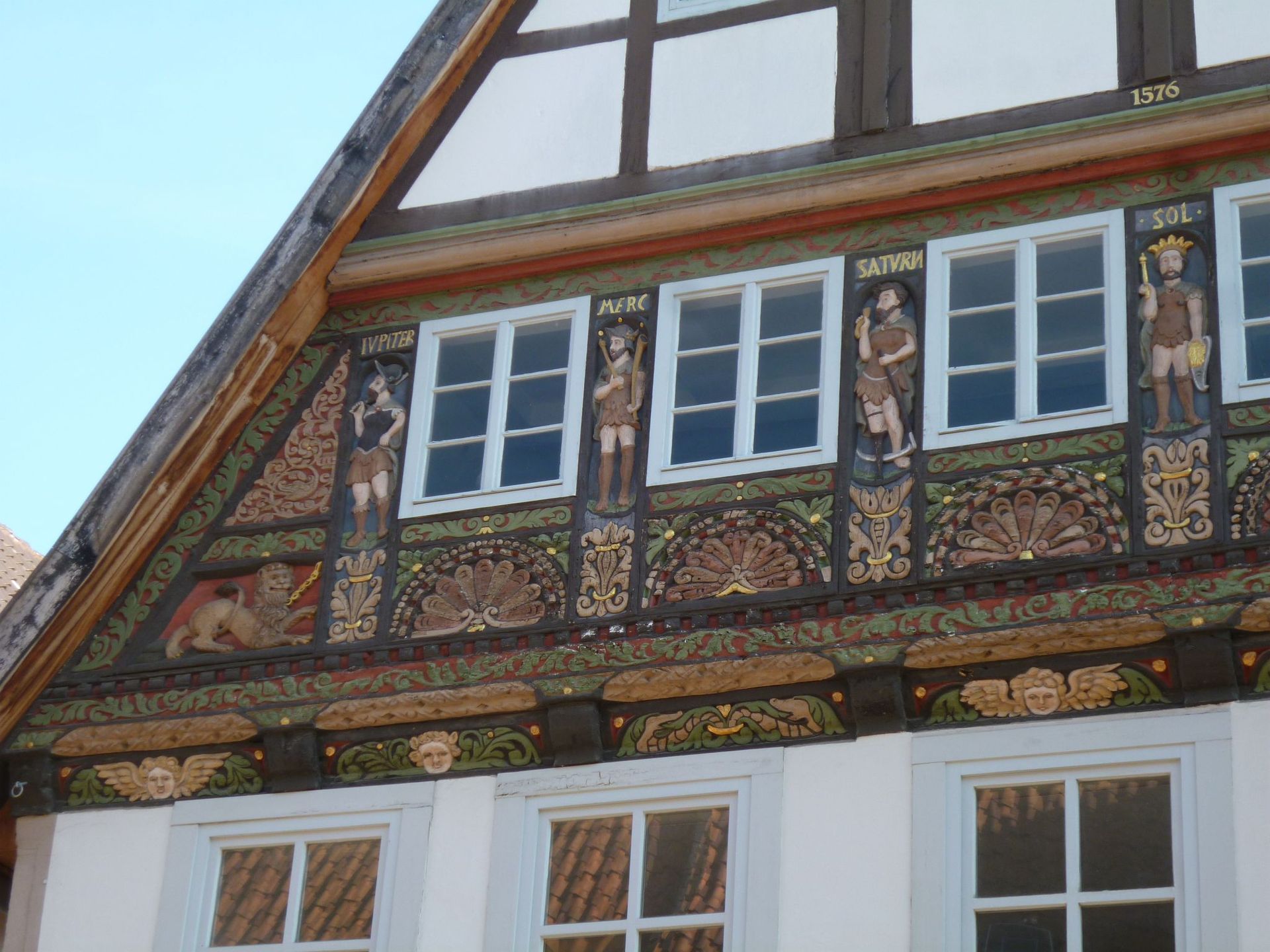
Opposite the ice-cream parlour stands the ‘Planetenhaus’. Above the optician’s, you can see wooden reliefs on the upper part of the façade, featuring figures associated with the planets.
A little further on is the Rossmann chemist’s in the ‘Haus Sonnenuhr’; to its right are two very beautiful carved façades. Opposite is a magnificent half-timbered gable, and a little further along on the south side is a historic town house with a large carved decorative gable dating from the Weser Renaissance period. Walking past the shoe shop, you’ll come to three beautifully restored houses that once housed a fashion shop, featuring projecting signs with gilded figures of people in historical dress.
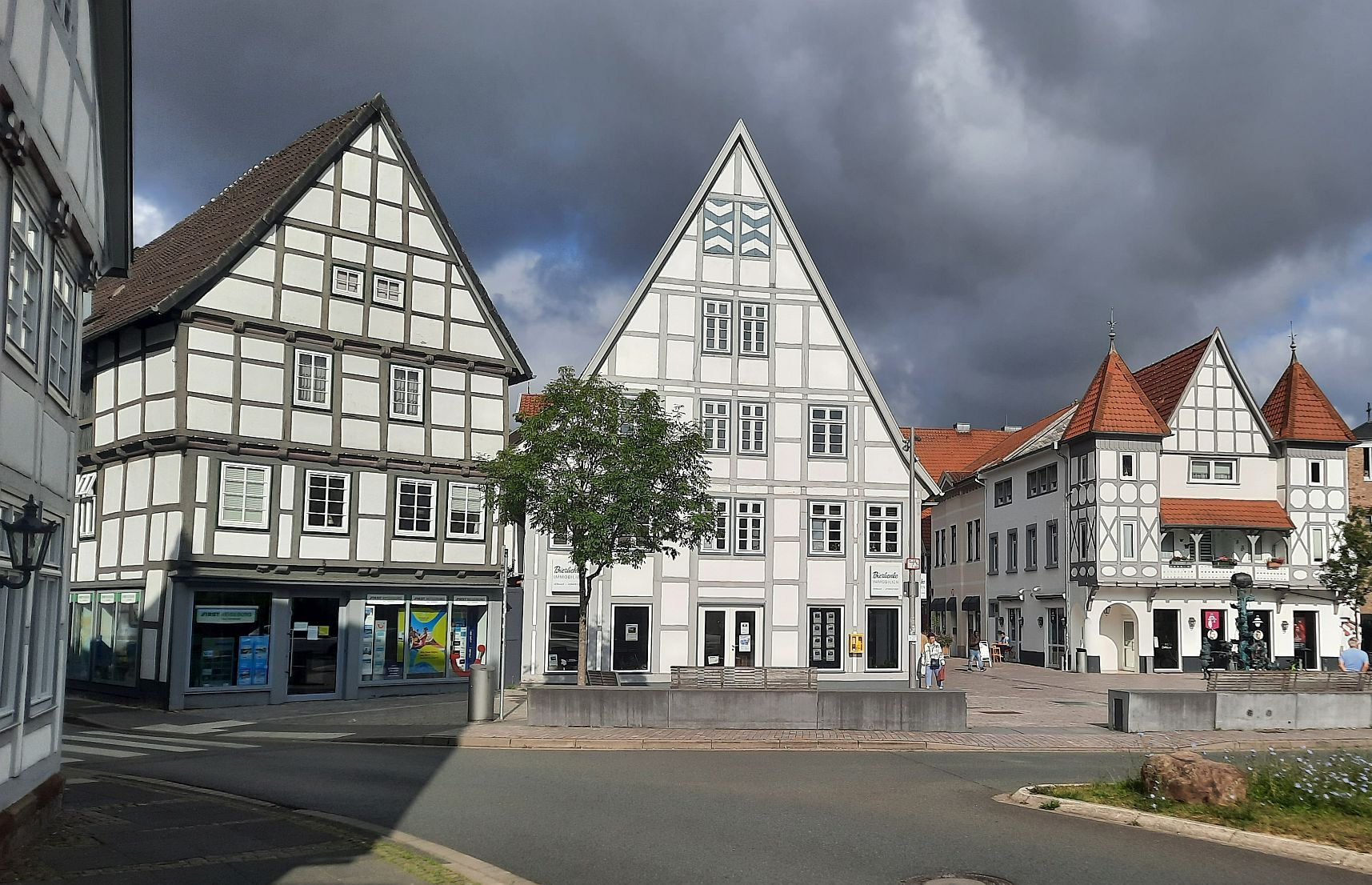
In any case, you should walk to the end of Mittelstraße, right up to the benches behind the fountain. If you turn round here, you’ll see the beautiful half-timbered houses at the Ostertor.
Papenstraße
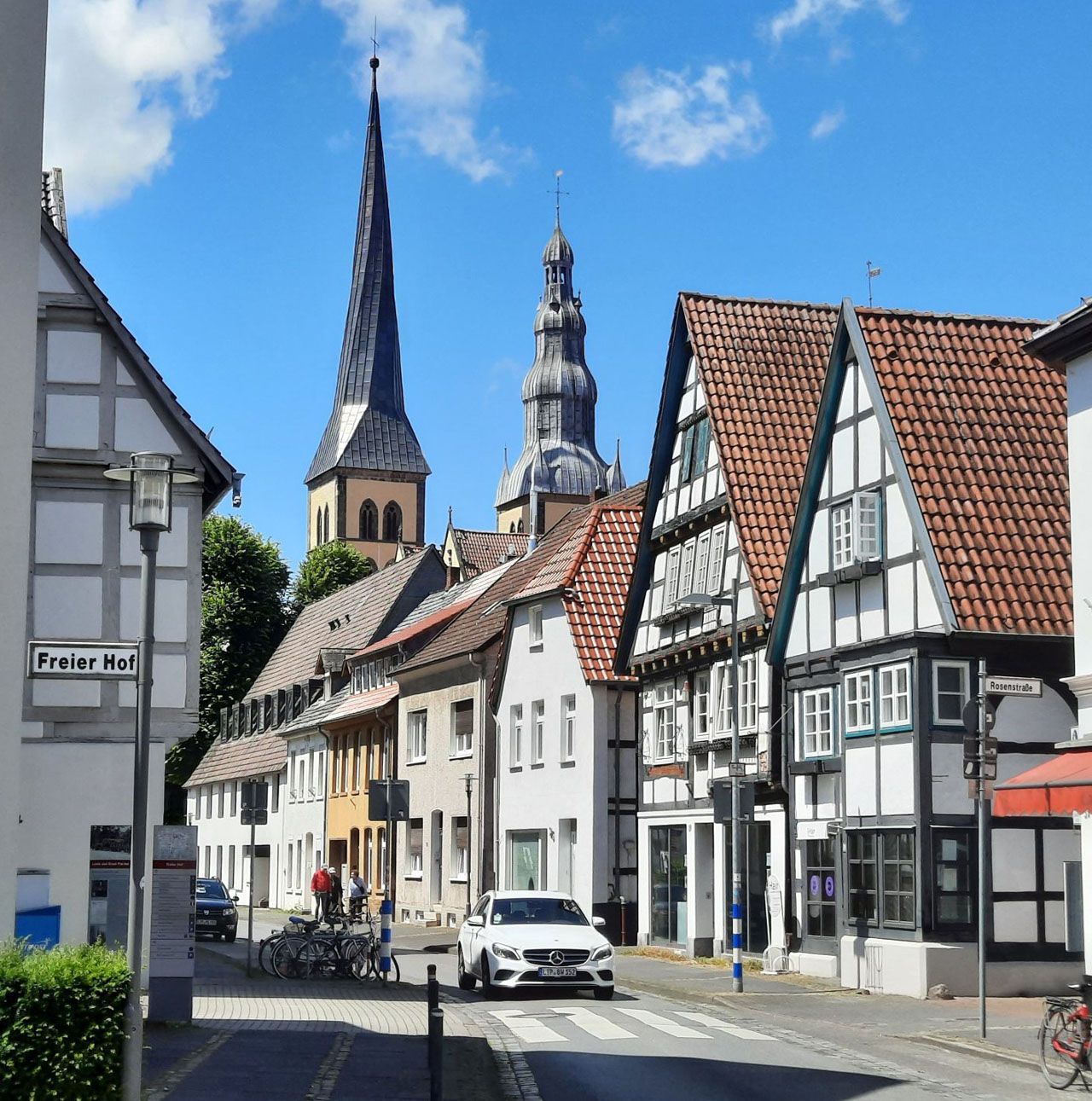
From the end of Mittelstraße, turn right into Papenstraße and, where the road curves, you’ll see half-timbered houses of various sizes. A little further on, on the corner with ‘Freier Hof’, stands an imposing building housing the Vesuvio restaurant. It has a stone façade with a delicately decorated wooden gable. If you continue to the zebra crossing, you’ll see the old building of the Hotel Stadtpalais – the former Kerssenbrock’sche Hof – on your left just beyond it. On the right-hand side of the zebra crossing is the Eikmeier bakery, which is well worth a visit. You should buy a few biscuits or a croissant there – one that will leave you feeling full once you’ve eaten it.
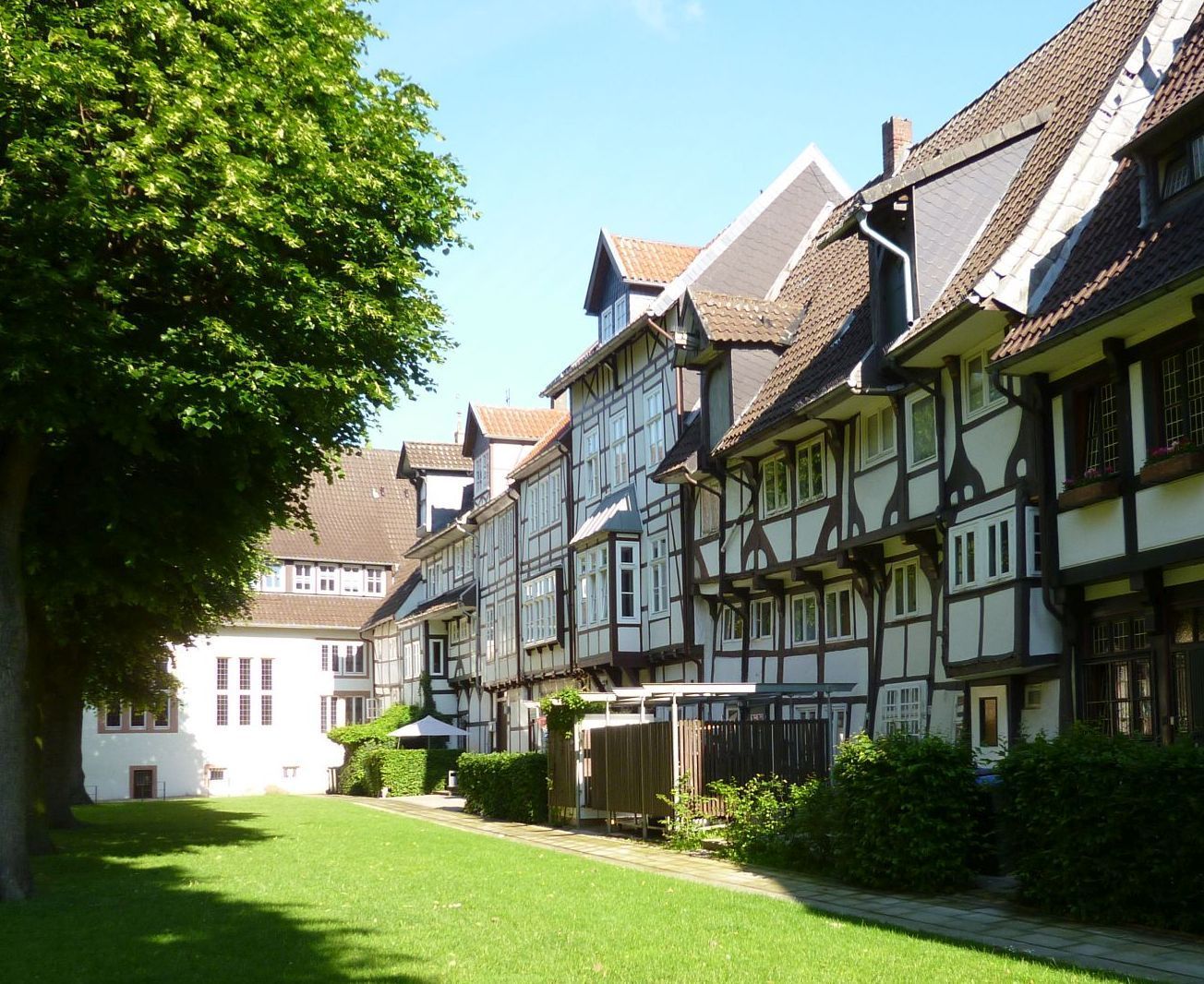
The walk continues to St Nicolai’s Church. Behind the towers on the right, you reach the church square and can see the winding half-timbered façades of the small shop-houses on Mittelstraße. On the left, between the half-timbered houses and the town hall, you return to Mittelstraße and the market square. From here, you can walk south back to the starting point, or extend the walk to include the western section of Mittelstraße and Echternstraße.
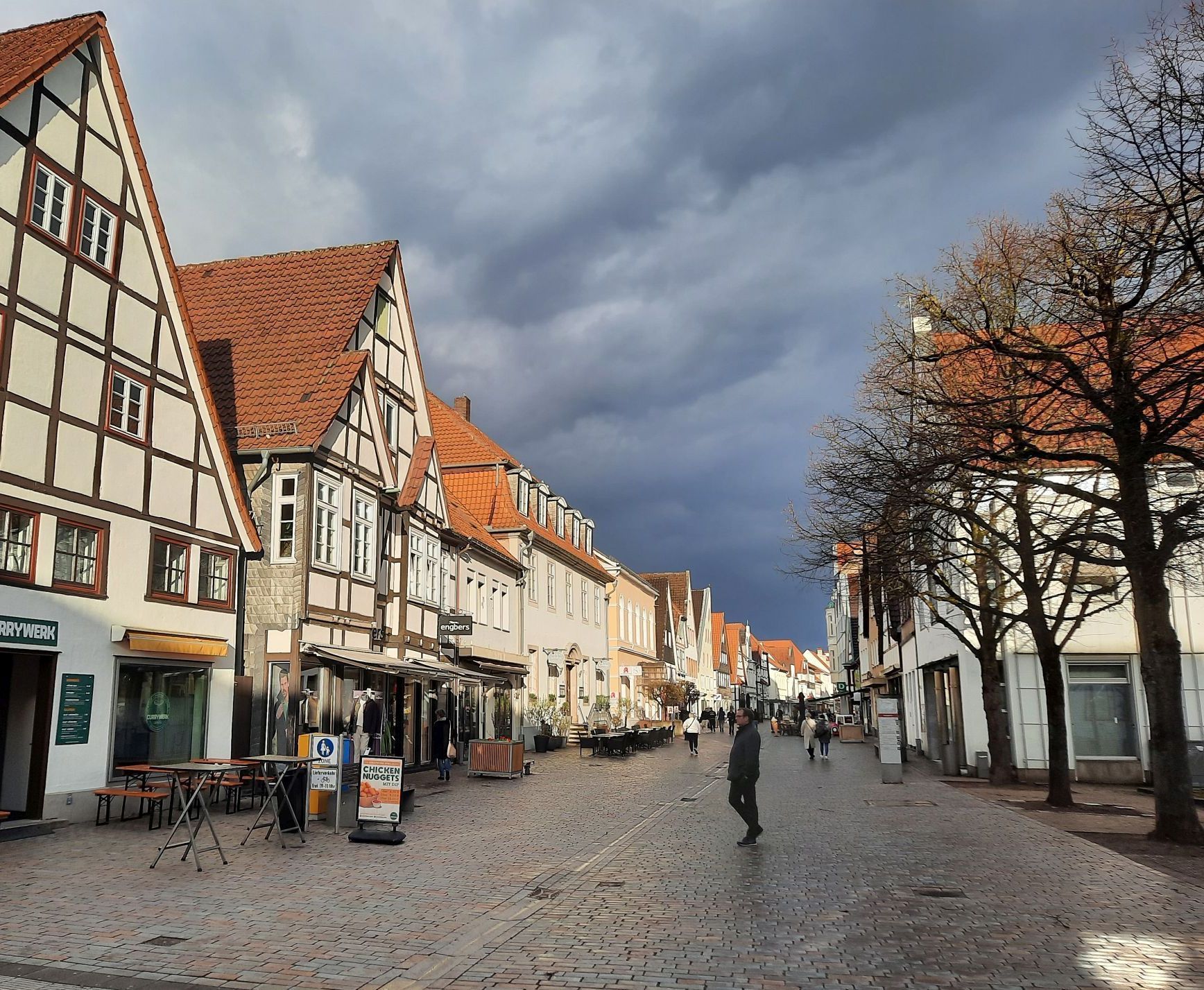
Mittelstraße, eastern part
This part of the pedestrian zone also features attractive houses, interesting shops and restaurants. At the end, on the left, lies the Lippegarten, with a fountain and several rows of trees. What was originally laid out as a garden has now become a multi-purpose square for town festivals, whose lawn often still looks a little bedraggled from the previous event. Behind the square, you can see a Baroque complex comprising the buildings of a former nobleman’s estate, which now houses a grammar school. On the way back through Mittelstraße, turn left behind the ‘Intersport’ and walk through a narrow passage right to the back, out onto Echternstraße.
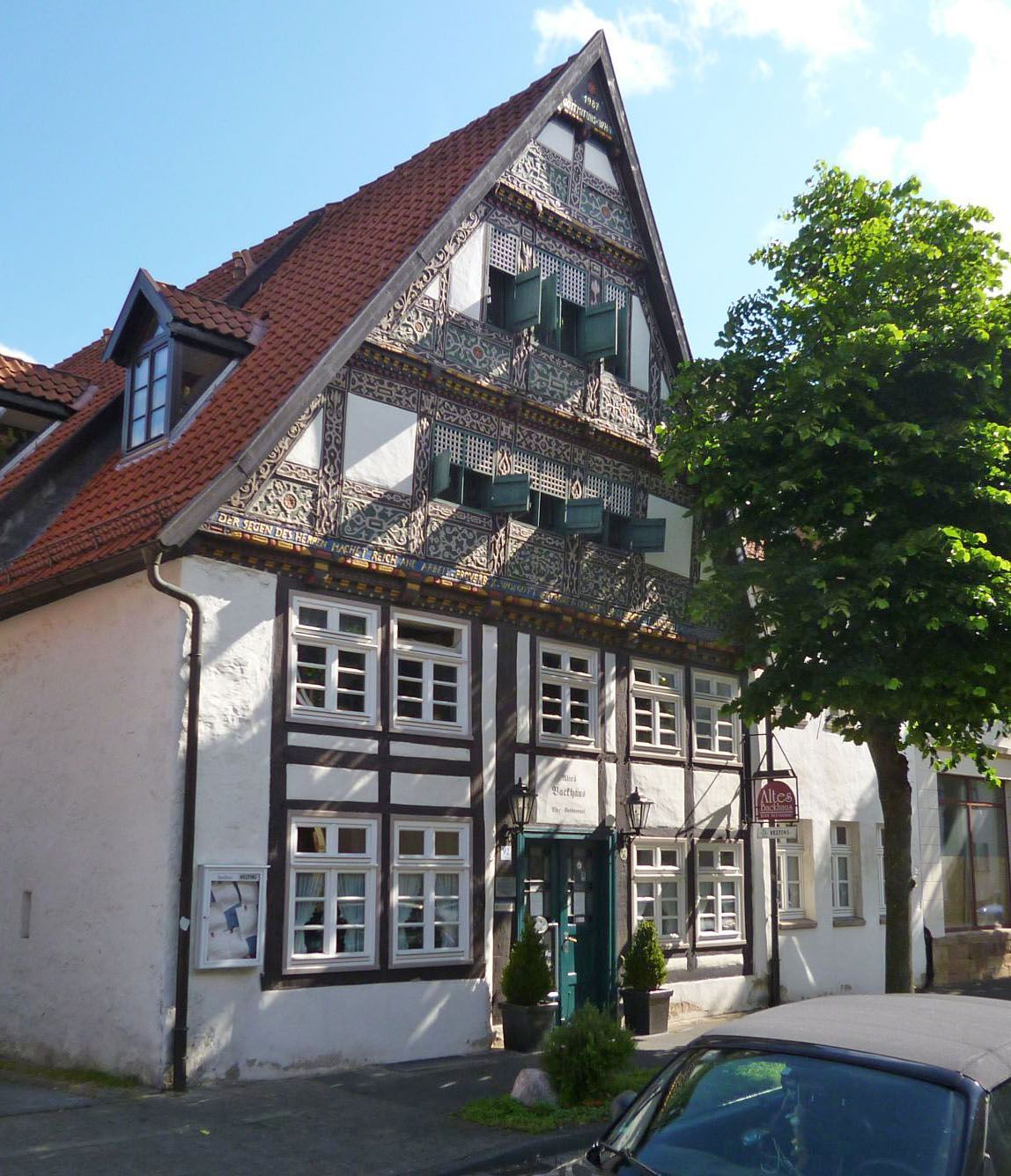
Echternstraße
Once you’ve passed through the passageway just mentioned, you should cross to the other side of the road and turn round. Here, too, there is a historic façade with a carved frieze on the upper storey – this time on the long side of a building. If you walk east along Echternstraße, you’ll see some lovely little half-timbered houses on both sides of the road. Before the pedestrian lights, turn right into Haferstraße; following its course through Kramerstraße (past the market square) and Breite Straße, you’ll return to the bridge over the Bega.
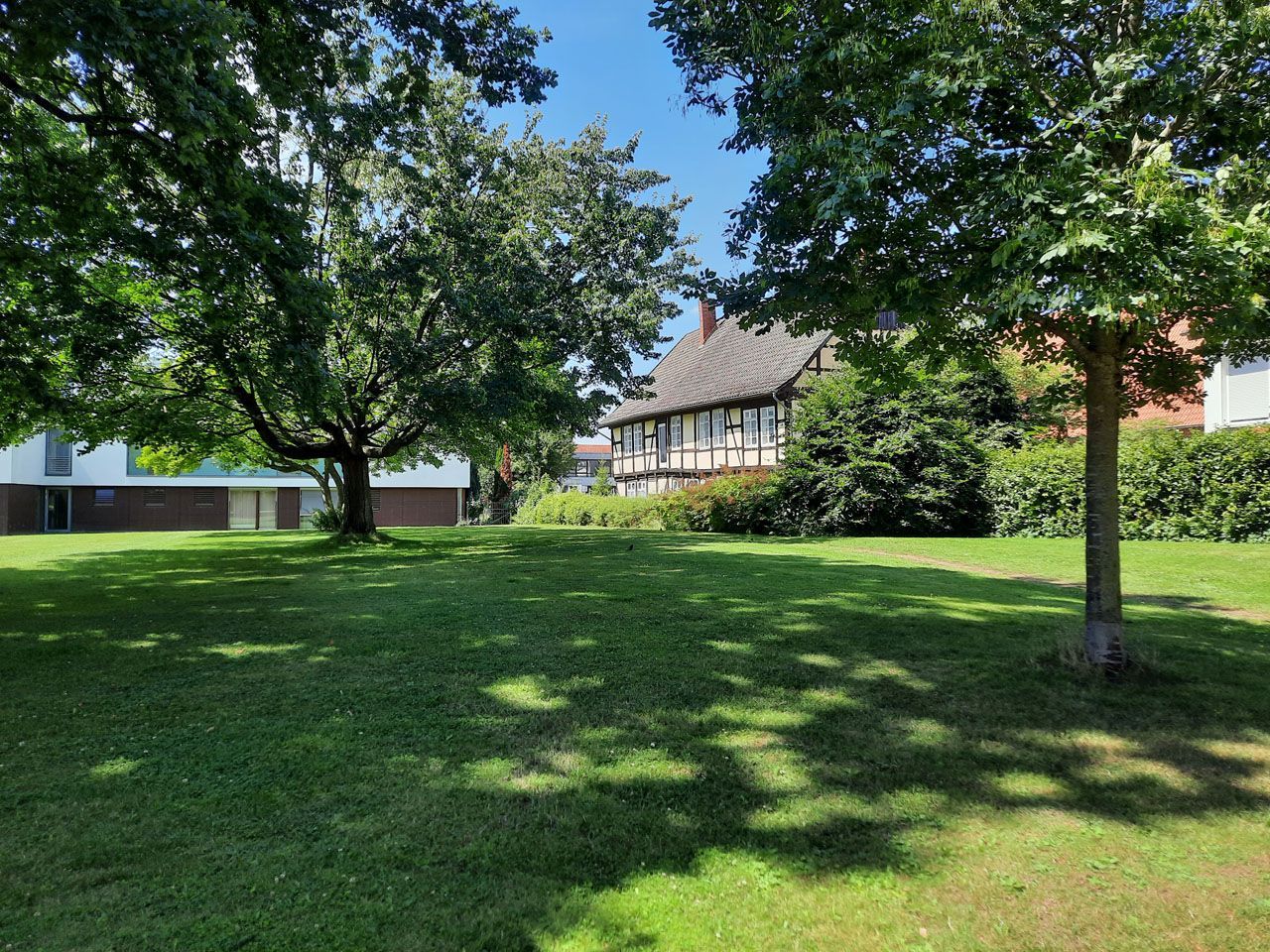
Return journey to the starting point
If you walk along Breite Straße towards the starting point at the bridge over the Bega, you should turn right onto Stiftstraße and walk round St Mary’s Church.
To the right of the church door, walk between the wall and the church, then turn left and walk round the church. This takes you to the St. Marien Stiftsgarten: a peaceful, shady meadow beneath oak trees, framed by historic and modern architecture.
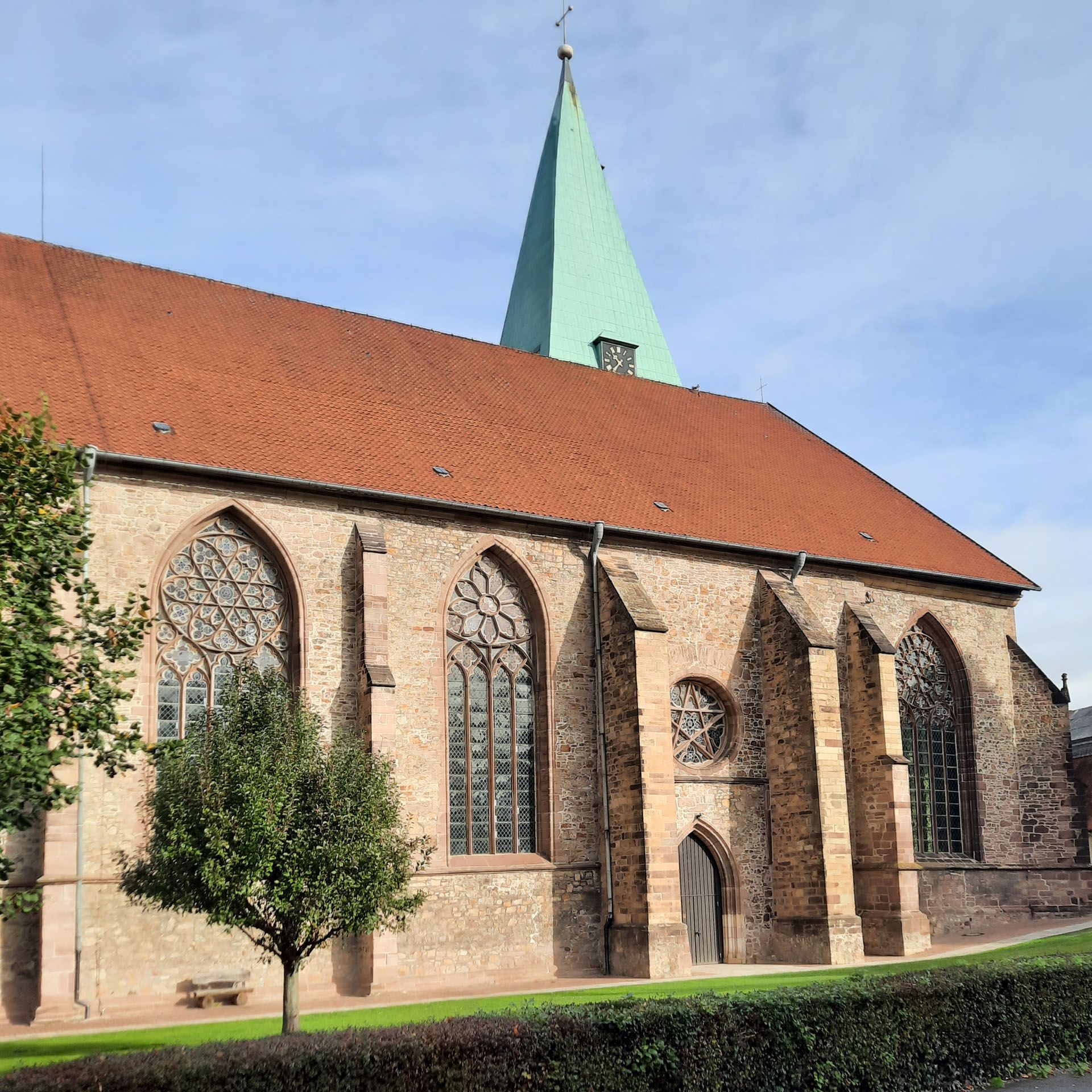
If you walk south through the opening in the rubble-stone wall, you will find yourself back on Breite Straße, having turned left onto Heustraße. As you do so, you will see the imposing rubble-stone façade of St Mary’s Church, an early-Gothic hall church which was built from 1260 onwards and consecrated in 1320.
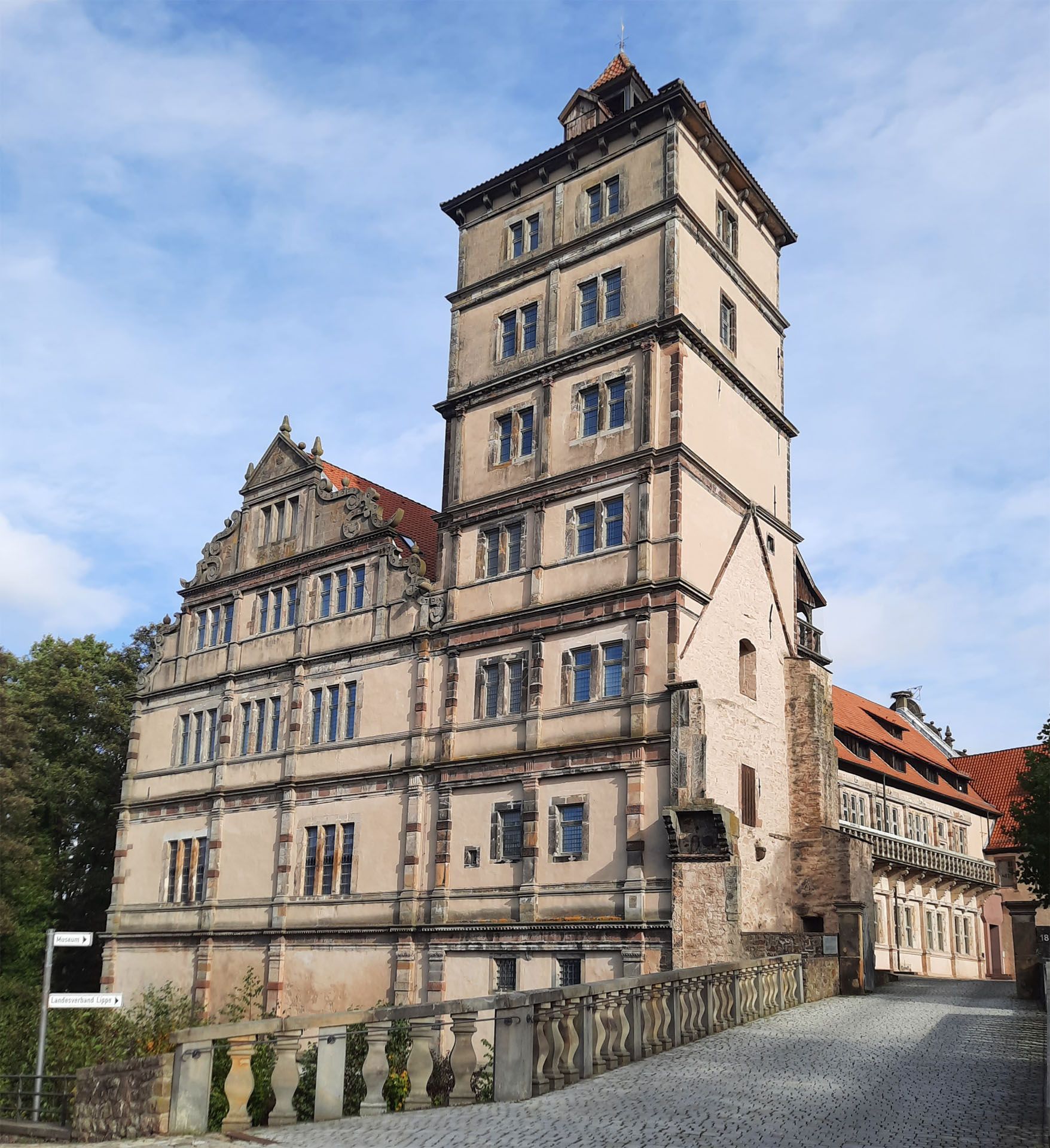
Brake Castle
The castle was built in the Renaissance style as the residence of the Counts of Lippe. Crossing the stone bridge, you reach the Weser Renaissance Museum on the right, whose permanent exhibition in the vaults beneath the castle extends all the way to the tower. Two very different staircases lead up to the exhibition rooms at the top of the tower, from where there is a magnificent view. Outside the moat, you can walk around the castle, preferably anti-clockwise. Once you reach the rear, you can see the castle’s façade reflected in the water. A narrow path running alongside the castle’s façade leads back to the cobbled street in front of the castle. Just 100 metres south-east of the castle, the oil mill is well worth a visit. You can park in the car park in front of the district court.
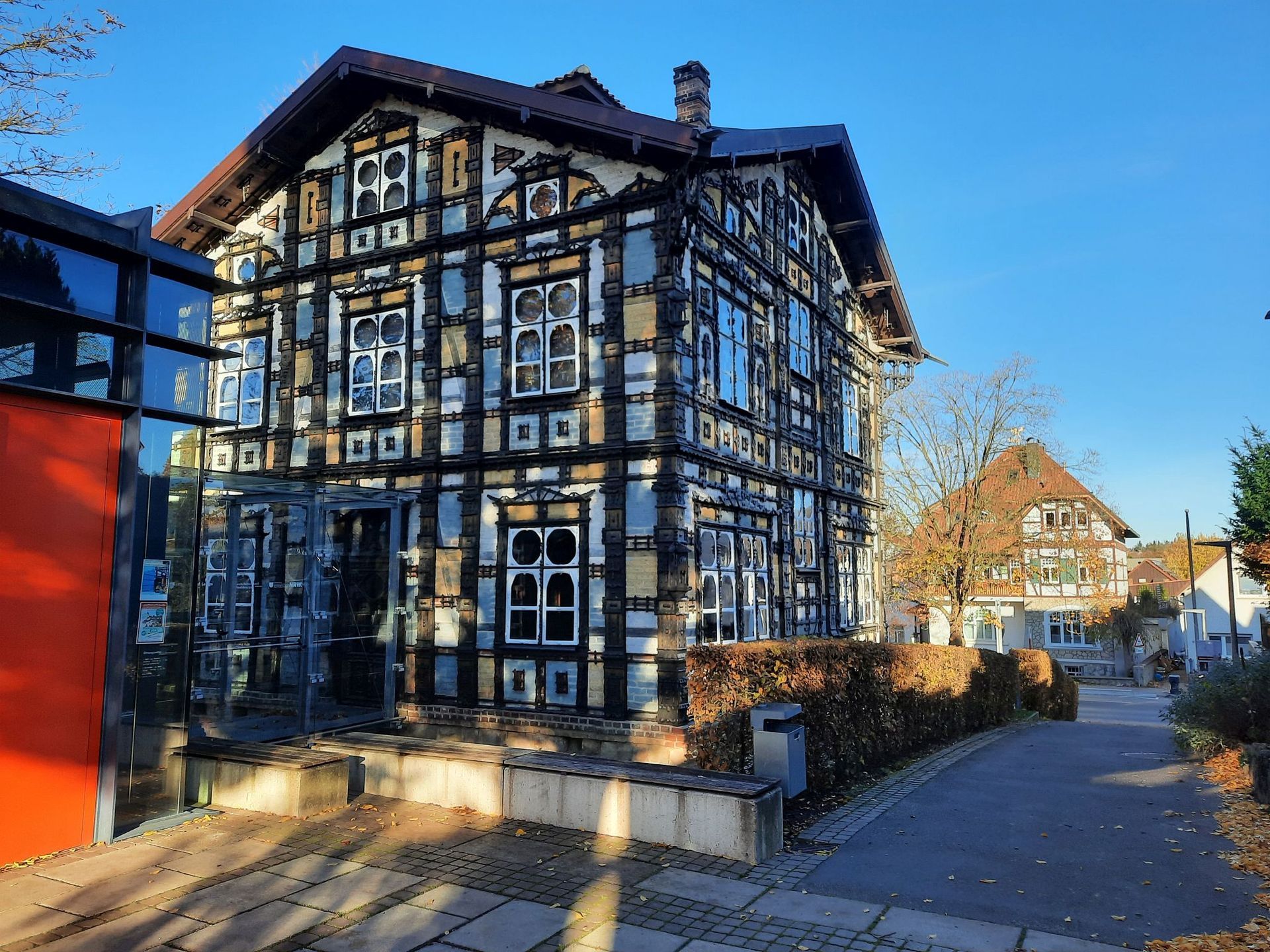
Junkerhaus
The unconventional Karl Junker decorated the entire façade, the interiors and the furniture with wood carvings. The artist lived in this house, which is definitely worth seeing both from the outside and the inside. The 800-metre walk along Bismarckstraße and Hamelner Straße isn’t particularly appealing, but the destination is well worth the effort. The city bus stops in front of the museum. There is a car park 200 metres further out of town on the right-hand side.
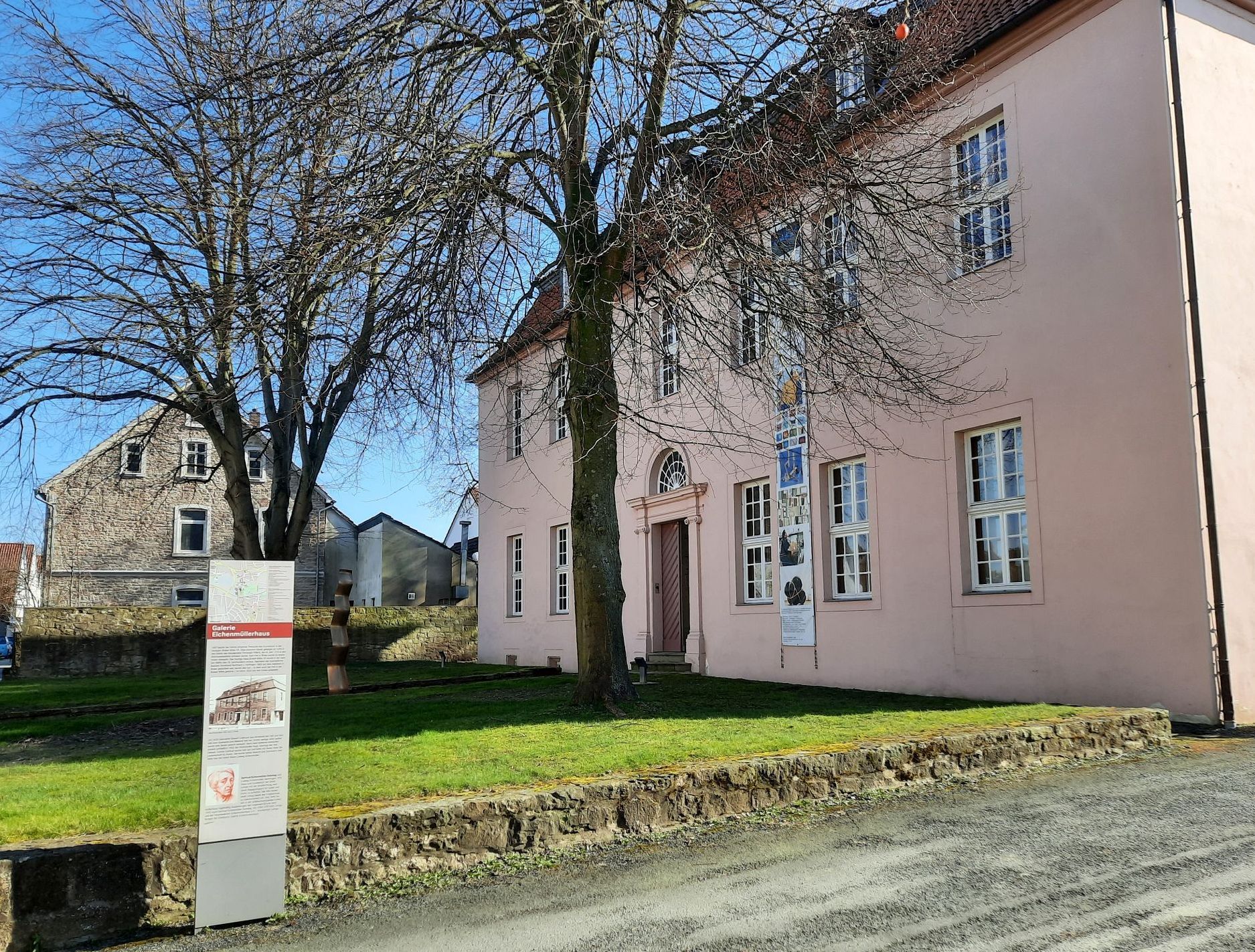
Eichenmüllerhouse
The Eichenmüllerhouse in the Brake district is named after its former owners. They donated this late Baroque townhouse to the town of Lemgo so that it could be used as a municipal gallery. The building is open from Thursday to Sunday during the numerous exhibitions of contemporary art. The city bus stops at ‘Braker Mitte’, the street on which the Eichenmüllerhouse is situated. Parking is available on the premises.
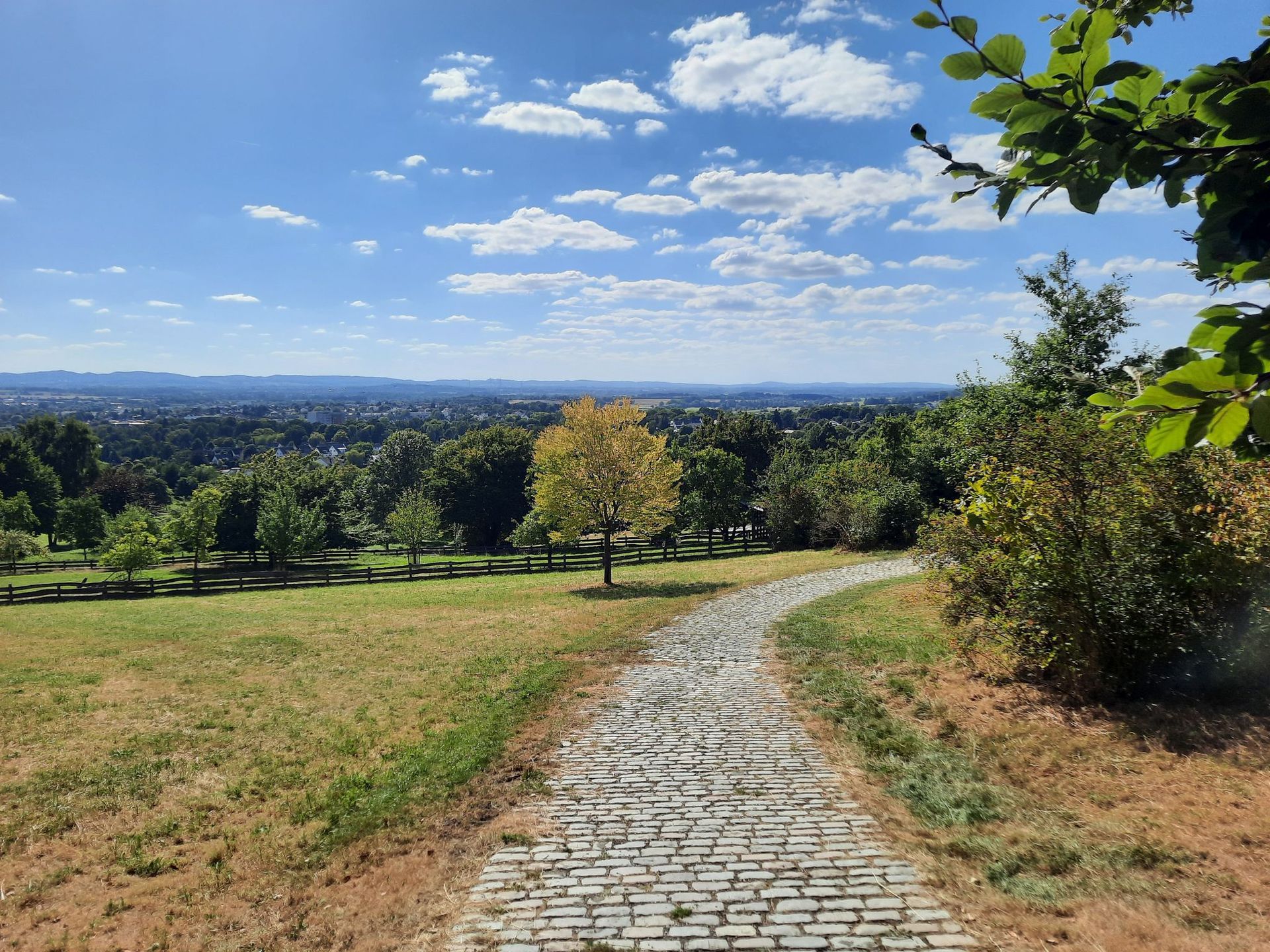
Staff Landscape Park ("Staff" is a brand name)
The owners of the former Staff lighting factory lived in a villa below the town forest and ensured an unobstructed view by purchasing the surrounding farmland. This was a blessing for the town, as they later established the charitable Staff Foundation, and the large park was created on the basis of an award-winning competition design. Orchards with a mix of fruit trees and flower meadows, as well as abstract artworks scattered throughout the park, contribute to its charm. From the higher ground, there is a beautiful view of the town and the Lipperland region, including the Teutoburg Forest.
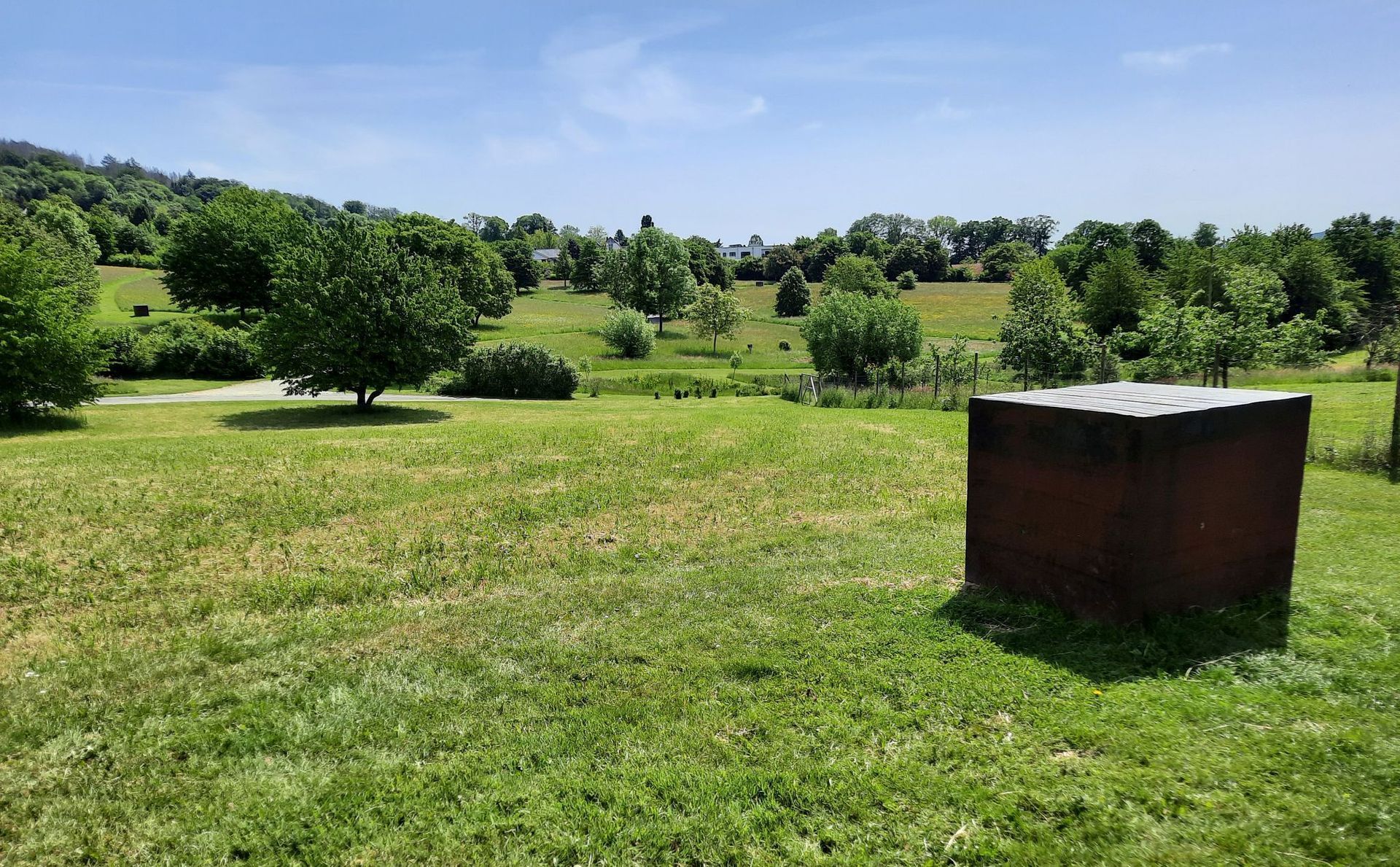
In the park there are three steel trusses by the artist Richard Serra, which are positioned at exactly the same height at various points throughout the grounds.
The city bus stops at ‘Am Kolk’. From there, it is 300 metres to the park along the street ‘Am Kolk’, up the Spiegelberg, and then you enter the park on the left via the car park. If you then turn right and walk up the path, after 150 metres you’ll come to a bench with a lovely view. The car park is situated on Spiegelberg, diagonally opposite the street “Im Obstgarten”. It’s easily accessible by e-bike, but if you’re on a standard bike, be prepared for a fairly steep climb.
Getting there
If travelling by car, drive to the Langenbrücker Tor car park and start the walking tour on Breite Straße. Alternatively, park in the Wüste multi-storey car park on Rampendal. Here, your car will be in the shade in summer and you can start the walking tour on Mittelstraße.
By bike, cycle to the southern end of Breite Straße. Near the bridge there are ten bike racks for locking up your bike, and a further nine in front of house number 11. From here, you can explore the town on foot.
If travelling by train, get off at Lemgo station and then walk north. After crossing the bridge over the River Bega, turn right onto Hohen Wall and walk to Breite Straße, where you can start the walking tour. If you’d like to visit Brake Castle or the Eichenmüllerhaus first, take the train one stop further to the terminus at Lemgo-Lüttfeld.
Public toilets are available at the Langenbrücker Tor car park at the southern end of Breite Straße. There are also toilets in Diebesgasse, south of the market square, and at the Neue Torstraße car park, north of the market square.
The walk starts at the Wüste car park
Head south along Engelbert-Kämpfer-Straße and, just past Heustraße, turn diagonally left into the park. From here, head uphill and turn left over the Hoher Wall towards Breite Straße. This is a distance of about 600 metres, but once you’ve completed the walk, you’ll find yourself back near the car park at the western end of Mittelstraße.
The walk starts at the campsite
Turn left onto Regenstorstraße and, at the pedestrian traffic lights, turn left onto Lindenwall, along which you’ll reach the starting point after 700 metres. To get from the ‘Heimatcamping’ campsite to Mittelstraße, turn right at the pedestrian traffic lights, walk along Kastanienwall and turn left at the roundabout. It is only 800 metres in total to the market square. It is just around 700 metres on foot from Heimatcamping Lemgo to Brake Castle, and on the way you’ll pass the idyllically situated old oil mill.
About this website
At the next table in a café sat two people who had come to Lemgo on the spur of the moment. Using two smartphones, they were trying to find out what was worth seeing in Lemgo. They either found only scattered bits of information – “Apparently there’s a castle here” – or complex virtual options – “I don’t feel like doing that right now”. As the tourist information centres in many towns are closed on Saturday afternoons and Sundays, they didn’t even bother looking for a leaflet with a town map. It seems that tourism only takes place on weekdays – but online, it’s possible at the weekend too.
That is why this deliberately simple city guide has been created. It has been written by someone who was born in Lemgo, lived in large cities whilst studying and working, was happy to return to Lemgo, and has retained a bit of an outsider’s perspective on the town. The insider tips on sights and restaurants are personal recommendations and have not been sponsored.
You can find more interesting places in the old Hanseatic town of Lemgo, complete with photo opportunities, along with pictures, descriptions and location details on the page
www.arnd.de/lemgo-motive.
This city guide is a private initiative by
Arnd Gatermann Grafic Art | Art | Design
Startseite | Architektur | Design
Vita |
Referenzen |
Über mich
IrfanView | Tipps | Lemgo-Motive
Lemgo-Rundgang | Freies Skizzieren
Mail: atelier@arnd.de